
Leverage, Specific Knowledge, and Judgment
Naval Ravikant’s Philosophy in the Age of AI

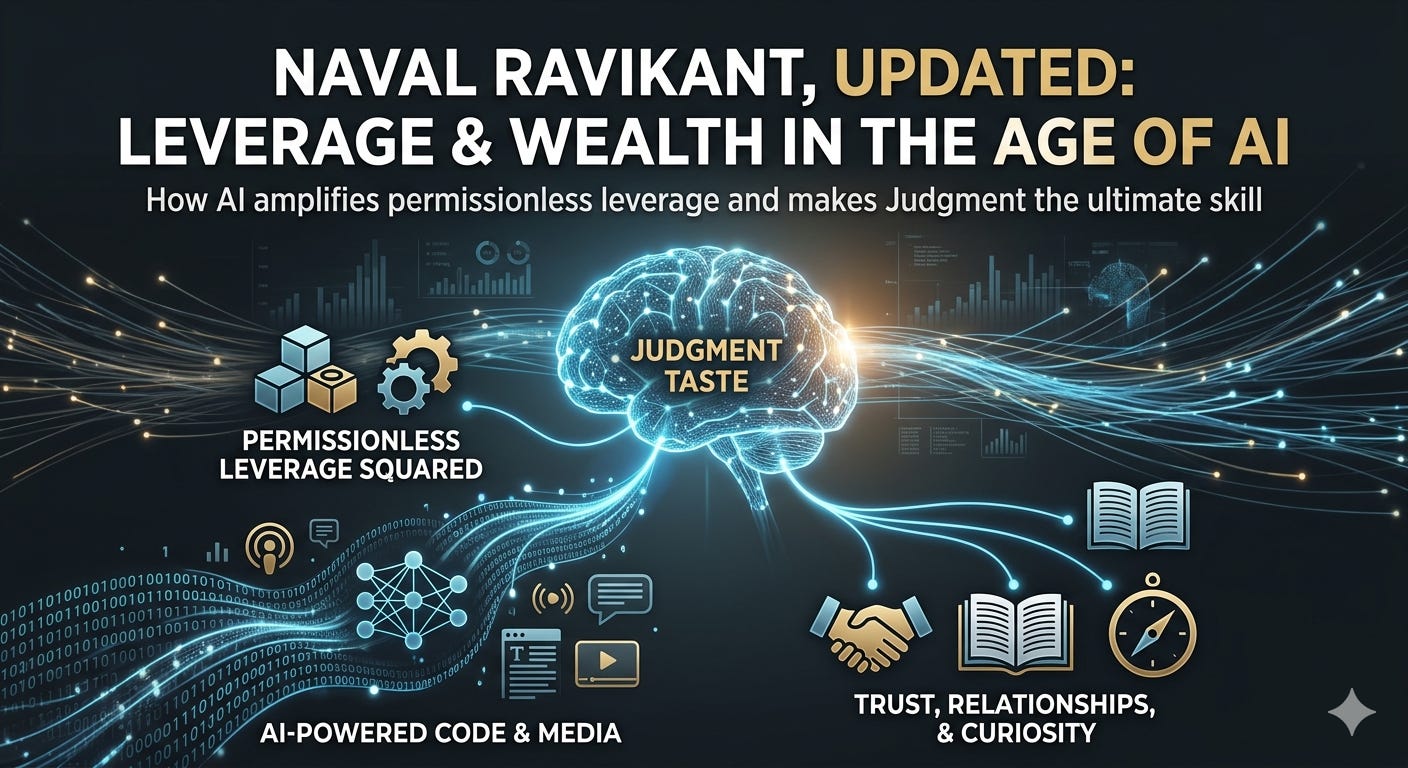
Who Is Naval Ravikant?
If you’ve spent any time in tech circles on X or LinkedIn, you’ve almost certainly encountered his words — even if you didn’t know they were his. “Seek wealth, not money or status.” “An army of robots is freely available — it’s just packed in data centers for heat and space efficiency.” “You’re not going to get rich renting out your time.”
Naval Ravikant is an entrepreneur, investor, and philosopher-entrepreneur whose 2018 tweetstorm “How to Get Rich (without getting lucky)” became one of the most viral threads in the history of social media. He co-founded AngelList (now Wellfound), was an early investor in Twitter, Uber, Notion, and dozens of other iconic startups, and became something rare in Silicon Valley: a billionaire who talks about happiness more than money. His collected wisdom was compiled by Eric Jorgenson into The Almanack of Naval Ravikant (2020) — a book that reads less like a business manual and more like a modern philosophical treatise on wealth, leverage, and the good life.
What makes Naval different from the typical tech guru is that his framework isn’t about hustle or grinding. It’s about leverage — finding ways to separate your inputs from your outputs, so your work compounds rather than merely accumulates. And in 2026, that framework is being stress-tested by the one thing that changes everything: artificial intelligence.
The Core Framework: What Naval Actually Said
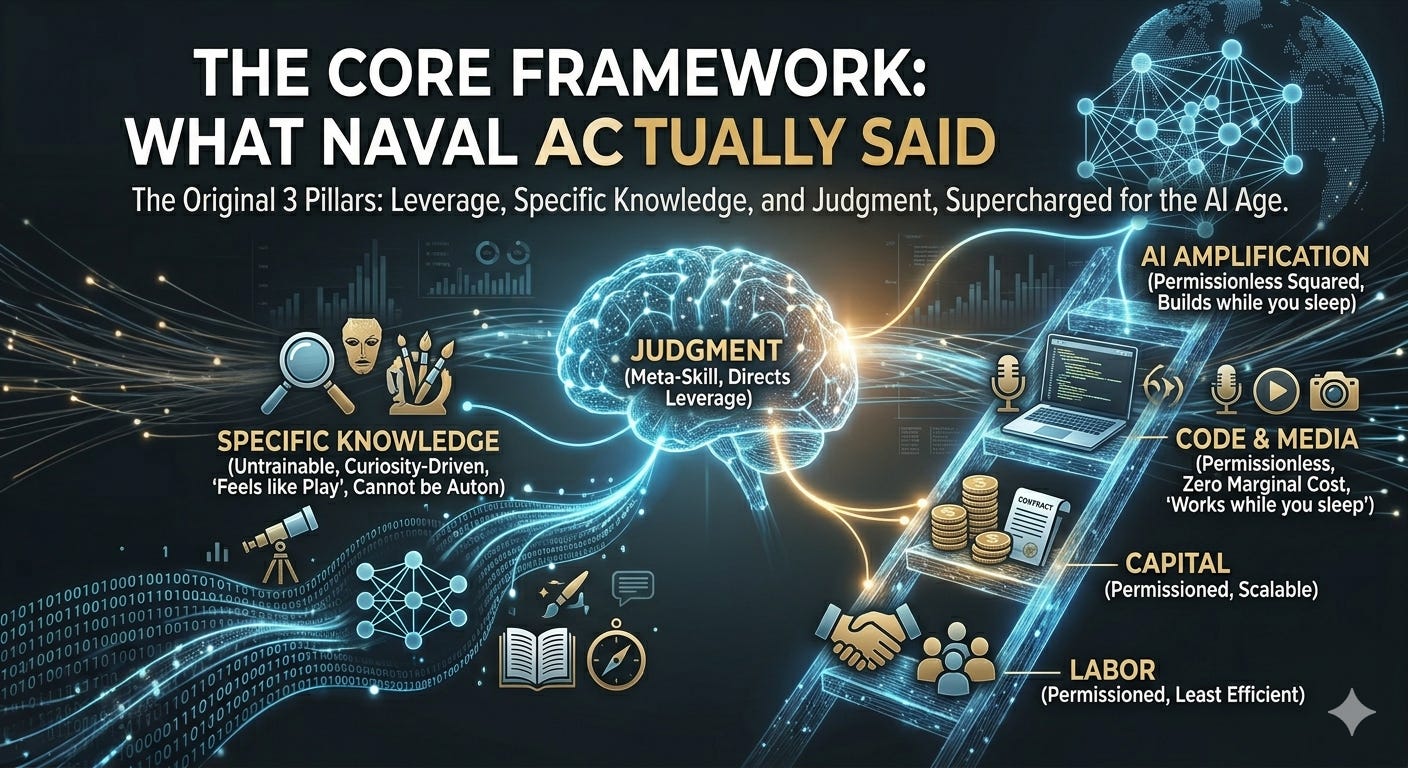
Before we examine how AI reshapes his ideas, let’s lay out the architecture of Naval’s thinking. Three pillars hold up the entire structure.
Pillar 1: Leverage — The Escalating Ladder
Naval identifies three forms of leverage, arranged in ascending order of power:
Labor — People working for you. The oldest form, the most fought-over, and in Naval’s view, the least efficient. “Don’t waste your life chasing it.” It’s permissioned — someone has to agree to work for you.
Capital — Money working for you. More scalable than labor, but still permissioned — someone has to give it to you.
Code and Media — Products with zero marginal cost of replication. This is the leverage behind the newly rich. It’s permissionless — you don’t need anyone’s approval. A line of code, a podcast, a blog post — these work while you sleep, serve millions at no extra cost, and compound over time.
The key insight: the gap between the rich and the super-rich isn’t effort — it’s the type of leverage they use.
Pillar 2: Specific Knowledge — The Untrainable Edge
“Specific knowledge is knowledge you cannot be trained for. If society can train you, it can train someone else and replace you.”
This is the anti-playbook. Specific knowledge isn’t found by chasing what’s hot — it’s discovered by pursuing genuine curiosity. It “feels like play to you but looks like work to others.” It’s often highly technical or creative. It’s taught through apprenticeships, not schools. And crucially, Naval says, it “cannot be outsourced or automated.”
Pillar 3: Judgment — The Meta-Skill
As your leverage grows, you’re increasingly paid for judgment rather than effort. The person with a thousand engineers reporting to them isn’t paid for writing code — they’re paid for knowing which code to write. Judgment is the meta-skill that directs leverage. “Show your specific knowledge with accountability and show resulting good judgment” — this, Naval argues, is how you raise capital, earn trust, and compound your advantages.
AI Enters the Frame: Naval’s Own Update
In February 2026, Naval released a 52-minute conversation with Nivi on nav.al/ai titled “A Motorcycle for the Mind” — his most direct engagement with AI to date. The title itself is telling: it echoes Steve Jobs’ famous description of the computer as a “bicycle for the mind,” but upgrades the metaphor from bicycle to motorcycle. AI isn’t just incremental improvement — it’s an order-of-magnitude amplification.
His key insights from that conversation:
“Vibe coding is the new product management. Training and tuning models is the new coding.” AI collapses the distance between taste and product. English becomes the programming language. Non-coders can now go directly from idea to working application.
AI transforms code/media leverage into something even more powerful. Code was already permissionless leverage. AI amplifies it further — you no longer even need to know how to code. The “army of robots packed in data centers” from his original tweetstorm is now literally available via LLMs.
A tsunami of applications, but differentiation matters. Naval predicts a flood of AI-generated apps. Just as anyone can now make a video or podcast, anyone can make an application. But creation ≠ competitive advantage. It breaks into two kinds of outputs — commodity outputs versus differentiated, taste-driven ones.
He’s building again. “I just wasn’t satisfied being an investor... people who just talk too much and don’t do anything haven’t encountered reality.” He’s practicing what he preaches — building with AI rather than merely commenting on it.
Where Naval Gets More Right: AI as Leverage Squared
The Leverage Upgrade
Naval’s three-tier leverage framework now has an implicit fourth tier: AI as permissionless leverage squared. Code was already “works while you sleep.” AI is “builds while you sleep.” The metaphorical army of robots he described in 2018 is now literally available via API. Consider the practical implications:
A solo founder in 2018 needed to either learn to code or find a technical co-founder to build a product. In 2026, that same founder can describe what they want in natural language and have a working prototype in hours. The barrier between idea and product has collapsed.
A content creator who once needed a team of writers, designers, and editors can now produce at the quality and volume of an entire media company. The barrier between taste and output has collapsed.
An enterprise leader driving AI transformation at scale — someone who previously needed to build consensus across departments, hire specialized teams, and navigate 18-month implementation timelines — can now prototype solutions in days and demonstrate value before the first steering committee meets. The barrier between vision and execution has collapsed.
This is Naval’s leverage thesis on steroids. Every form of permissionless leverage just got dramatically more accessible.
Judgment Becomes Even More Valuable
When anyone can build, the skill of knowing what to build becomes paramount. This is Naval’s judgment concept amplified — execution is commoditized, direction is scarce.
Ethan Mollick, professor at Wharton, makes this precise in his January 2026 piece “Management as AI Superpower.” His core thesis: “AI changes the equation. Now the ‘talent’ is abundant and cheap. What’s scarce is knowing what to ask for.” Mollick identifies three factors in what he calls the “Equation of Agentic Work” — the Jagged Frontier of AI ability, AI speed, and evaluation costs. The key constraint is evaluation — can you judge whether the AI’s output is actually good? This is judgment operationalized.
Paul Graham adds a darker dimension in his October 2024 essay “Writes and Write-Nots.” His argument: “Writing is thinking.” Those who outsource all writing to AI lose the capacity for clear thought. The implication is stark — AI doesn’t just commoditize execution, it threatens to commoditize thinking itself for those who surrender it. There will be people who use AI to amplify their thinking and people who use AI to replace their thinking. The middle ground disappears.
Where Naval Gets Challenged: Specific Knowledge Under Pressure
This is where things get uncomfortable. Naval said specific knowledge “cannot be outsourced or automated.” AI challenges this directly. Consider two examples:
Example 1: The Senior Engineer’s Dilemma
In 2020, a senior backend engineer’s specific knowledge — deep understanding of distributed systems, database optimization, API architecture — was genuinely hard to replicate. That knowledge took years to accumulate, felt like play to the engineer but looked like grueling work to others, and couldn’t simply be trained in a bootcamp. It met every criterion of Naval’s definition.
In 2026, an AI coding assistant can generate robust API endpoints, optimize database queries, and design distributed system architectures from a natural language description. The execution layer of that specific knowledge has been partially automated. What remains is the judgment layer — knowing which architecture to choose, why a particular optimization matters, and whether the AI’s output is actually correct.
The specific knowledge didn’t disappear. It migrated upward — from the technical execution layer to the judgment and taste layer.
Example 2: The Content Strategist’s Evolution
A content strategist in 2019 had specific knowledge: understanding audience psychology, knowing which headlines convert, sensing the cultural moment. Creating the actual content — writing the posts, designing the graphics, editing the video — was the time-consuming execution layer.
In 2026, AI handles the execution layer: generating drafts, creating graphics, editing video, even suggesting headlines based on engagement prediction models. But the strategist’s specific knowledge — knowing which stories matter, which voices are missing, which cultural currents are about to crest — that remains scarce. The strategist who used to be valued for both their strategic sense AND their production ability is now valued primarily for the former. The latter has been commoditized.
The Resolution: Specific Knowledge Migrates Upward
The pattern is consistent across domains: specific knowledge doesn’t disappear under AI pressure — it migrates upward. What’s specific about your knowledge is no longer that you can do something others can’t — it’s that you know what’s worth doing that others don’t.
Scott Belsky, Adobe’s Chief Product Officer, captures this in his January 2026 work “What Are We Gonna Do Now? Winning the Era of Superhumanity.” His argument: humans must become “jazz partners” with thinking technologies — improvisational, judgment-driven collaborators. When AI can execute anything, what you choose to make (and why) matters more than how you make it. Cultivate sources of taste — that’s the new specific knowledge.
swyx (Shawn Wang), in his “Tiny Teams Playbook” (2025), calls this being a “High Taste Tester” — when anyone can generate anything, the person who can evaluate quality becomes the bottleneck. Taste is specific knowledge in the AI era.
The Contrarian View: Where the Framework Might Break
It’s worth noting the framework isn’t universal. If everyone has access to AI leverage, competitive advantage shifts to those who control the underlying infrastructure (compute, models, data) rather than individual users, and structural policy questions like how to distribute AI’s gains fairly fall outside Naval’s individual-centric model. But for most people building, creating, or working in the AI age, the core insights remain highly actionable.
What Remains: The Irreducibly Human
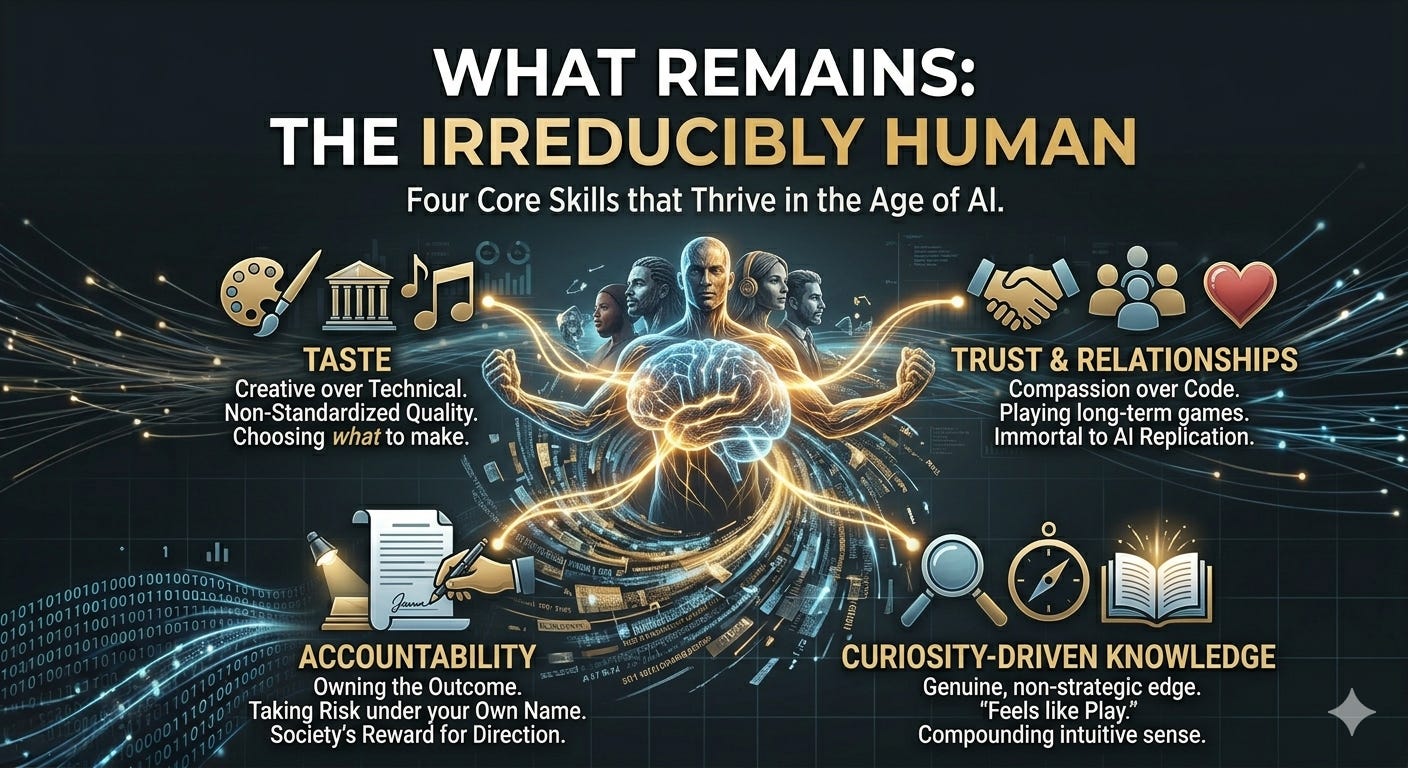
Despite the pressure from AI, several elements of Naval’s framework not only survive but become more valuable:
Taste
When anyone can build anything, what you choose to build — and the standard you hold it to — becomes the differentiator. Naval’s insight about specific knowledge being “often highly technical or creative” evolves: the creative dimension overtakes the technical. Taste is the new specific knowledge. It’s not about what you can make; it’s about what you choose to make and the quality bar you refuse to lower.
Trust and Relationships
“Play long-term games with long-term people.” Compound interest in relationships is immune to AI replication. People buy from people they trust. They invest in people they trust. They follow people they trust. AI can generate content, but it cannot generate trust — that requires consistent human presence over time.
Accountability
“Take risk under your own name.” Naval’s concept of accountability becomes even more powerful when AI can do the work — you’re not accountable for the effort, you’re accountable for the direction. Society rewards those who put their name on the line. AI cannot be accountable. It can produce, but it cannot own the outcome.
Curiosity-Driven Knowledge
The “feels like play to you but looks like work to others” quality. AI can replicate trained knowledge, but the compounding, curiosity-driven edge that creates genuine insight remains human. The person who spends a decade obsessing over a domain because they genuinely love it — not because it’s strategic — builds an intuitive sense that no AI can replicate, because AI doesn’t care. It doesn’t have curiosity. It has capability without conviction.
The Happiness Question: More Relevant Than Ever
Naval’s philosophy isn’t just about wealth — it’s equally about happiness. And here, AI raises uncomfortable questions.
His framework: “Happiness is what’s there when you remove the sense that something is missing in your life.” Desire is the enemy. “The fewer desires I can have, the more I can accept the current state of things.” Reality is neutral — it has no judgments. The three big pursuits — wealth, health, happiness — are chased in that order, but their importance is the reverse.
AI accelerates output. It raises the ceiling of what’s possible. But it also raises expectations. When you can produce 10x more, the implicit question becomes: why aren’t you producing 10x more? When your competitors are shipping daily, the desire for more — more output, more growth, more scale — intensifies rather than diminishes.
This is where Naval’s happiness framework becomes a survival skill, not just a nice-to-have. The question isn’t “can AI make me more productive?” — it’s “does being more productive make me happier?” If desire is the enemy, then AI — the ultimate desire-amplifier — is both the solution and the problem.
Shane Parrish, in Clear Thinking (2023), provides the mental model infrastructure for this. His focus on deliberate decision-making, emotional regulation, and recognizing when you’re reacting rather than thinking maps directly onto what Naval describes as the happiness skill. In the AI age, the ability to step back from the acceleration and ask “is this actually what I want?” may be the most countercultural — and most valuable — skill of all.
Synthesis: The Updated Framework
Naval Concept Pre-AI Meaning AI-Age Update Leverage Code/media = permissionless leverage AI = permissionless leverage squared — code generation without coding Specific Knowledge Can’t be trained, can’t be automated Technical skills erode; taste, relationships, and vision survive Judgment Paid for directing leverage The primary scarce skill when execution is commoditized Build vs. Sell Learn both “Build” gets democratized by AI; “Sell” (taste, trust, distribution) becomes harder to replicate Compound Interest In relationships, knowledge, wealth AI accelerates compounding of knowledge; relationship compounding remains human Accountability Take risk under your own name Even more valuable when AI can do the work — you’re accountable for the direction Happiness Desire reduction, reality is neutral More urgent — AI amplifies desire; the skill of wanting less becomes the ultimate competitive advantage
Practical Action Steps for You
You don’t need to overhaul your career overnight to apply these insights. Try one small change this week:
Audit your leverage: Are you still trading hours for dollars? Can you turn one repeatable task you do often into a template, AI workflow, or piece of content that works for you even when you’re not?
Test your judgment: Next time you ask AI to generate something, spend 10 minutes evaluating its output first before editing. Ask yourself: What is it missing? What would I have done differently? That’s your judgment muscle getting stronger.
Double down on your curiosity: Spend 30 minutes this week on a niche topic you care about that has nothing to do with your job. That’s the seed of the specific knowledge no AI can replicate.
Final Thought
Naval wrote his framework for a world where building things required specialized technical skill. We now live in a world where building is easy – but choosing what to build, and why, is harder than ever. The core truth remains: you don’t get rich by working harder. You get rich by working on things that compound, using leverage that scales, and leaning into the parts of you that are irreplaceably human.
If you tried any of these steps, or have your own take on applying Naval’s ideas to the AI age, drop a comment below. Follow for more reflections on AI, work, and how to build a career that works for you, not the other way around.
Ian Xie
May 17, 2026
ian.us.ci
Sources: nav.al/ai — Naval & Nivi, “A Motorcycle for the Mind” (Feb 2026); navalmanack.com — Chapters on Wealth Creation, Leverage, Specific Knowledge, Judgment, Happiness; Ethan Mollick — “Management as AI Superpower” (Jan 2026), oneusefulthing.org; Paul Graham — “Superlinear Returns” (Oct 2023), “Writes and Write-Nots” (Oct 2024); Scott Belsky — “What Are We Gonna Do Now? Winning the Era of Superhumanity” (Jan 2026); swyx — “Rise of the AI Engineer” (2023), “Tiny Teams Playbook” (2025); Sam Altman — “Moore’s Law for Everything” (2021); Daron Acemoglu & Simon Johnson — “Power and Progress” (2023); Sahil Lavingia — “GOD Mode” (2024), “The Minimalist Entrepreneur” (2021); Shane Parrish — “Clear Thinking” (2023); Ben Thompson — Stratechery newsletter; Emad Mostaque — various talks/essays.